模板方法模式(Template Method)
模板方法模式是一种行为设计模式, 它在超类中定义了一个算法的框架, 允许子类在不修改结构的情况下重写算法的特定步骤。
模板方法模式建议将流程算法分解为一系列步骤, 然后将这些步骤改写为方法, 最后在 “模板方法” 中依次调用这些方法。 步骤可以是 抽象的, 也可以有一些默认的实现。 为了能够使用算法, 客户端需要自行提供子类并实现所有的抽象步骤。 如有必要还需重写一些步骤 (但这一步中不包括模板方法自身)。
其他概念
钩子
钩子(Hook) 是一种特殊的方法,定义在抽象父类中,用于在算法流程中提供可扩展的 “钩子点”,允许子类根据需要选择性地覆盖或补充算法的某些步骤。
作用
- 提供默认行为:钩子方法通常有一个默认实现(可以是空实现),子类可以不必强制重写。
- 控制算法流程:子类通过重写钩子方法,能够影响父类中模板方法的执行逻辑(例如条件判断)。
- 增强灵活性:在不改变模板方法骨架的前提下,让子类能够定制算法中的特定步骤。
示例代码
// 抽象父类(定义模板方法和钩子)
abstract class AbstractClass {
    // 模板方法:定义算法骨架
    public final void templateMethod() {
        step1();
        // 调用钩子方法
        if (hookMethod()) {
            step2();
        }
        step3();
    }

    protected abstract void step1(); // 抽象步骤(必须实现)
    protected abstract void step3(); // 抽象步骤(必须实现)

    protected void step2() {
        // 可选步骤(默认实现)
    }

    // 钩子方法:默认返回true,子类可重写
    protected boolean hookMethod() {
        return true;
    }
}

// 子类实现
class ConcreteClass extends AbstractClass {
    @Override
    protected void step1() {
        System.out.println("执行步骤1");
    }

    @Override
    protected void step3() {
        System.out.println("执行步骤3");
    }

    // 重写钩子方法,改变算法流程
    @Override
    protected boolean hookMethod() {
        // 根据业务逻辑决定是否执行step2
        return false;
    }
}
模板方法模式结构
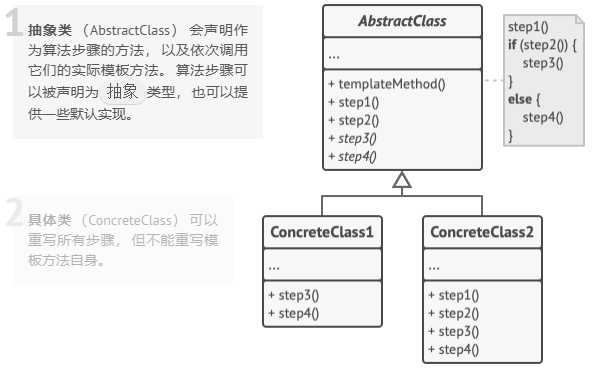
- 抽象类 (AbstractClass) 会声明作为算法步骤的方法, 以及依次调用它们的实际模板方法。 算法步骤可以被声明为
抽象类型, 也可以提供一些默认实现。 - 具体类 (ConcreteClass) 可以重写所有步骤, 但不能重写模板方法自身。
优缺点
| 优点 | 缺点 |
|---|---|
| 可仅允许客户端重写一个大型算法中的特定部分, 使得算法其他部分修改对其所造成的影响减小 | 部分客户端可能会受到算法框架的限制 |
| 可将重复代码提取到一个超类中 | 通过子类抑制默认步骤实现可能会导致违反里氏替换原则 |
| 模板方法中的步骤越多, 其维护工作就可能会越困难 |
示例代码
using System;

namespace RefactoringGuru.DesignPatterns.TemplateMethod.Conceptual
{
    // The Abstract Class defines a template method that contains a skeleton of
    // some algorithm, composed of calls to (usually) abstract primitive
    // operations.
    //
    // Concrete subclasses should implement these operations, but leave the
    // template method itself intact.
    abstract class AbstractClass
    {
        // The template method defines the skeleton of an algorithm.
        public void TemplateMethod()
        {
            this.BaseOperation1();
            this.RequiredOperations1();
            this.BaseOperation2();
            this.Hook1();
            this.RequiredOperation2();
            this.BaseOperation3();
            this.Hook2();
        }

        // These operations already have implementations.
        protected void BaseOperation1()
        {
            Console.WriteLine("AbstractClass says: I am doing the bulk of the work");
        }

        protected void BaseOperation2()
        {
            Console.WriteLine("AbstractClass says: But I let subclasses override some operations");
        }

        protected void BaseOperation3()
        {
            Console.WriteLine("AbstractClass says: But I am doing the bulk of the work anyway");
        }

        // These operations have to be implemented in subclasses.
        protected abstract void RequiredOperations1();

        protected abstract void RequiredOperation2();

        // These are "hooks." Subclasses may override them, but it's not
        // mandatory since the hooks already have default (but empty)
        // implementation. Hooks provide additional extension points in some
        // crucial places of the algorithm.
        protected virtual void Hook1() { }

        protected virtual void Hook2() { }
    }

    // Concrete classes have to implement all abstract operations of the base
    // class. They can also override some operations with a default
    // implementation.
    class ConcreteClass1 : AbstractClass
    {
        protected override void RequiredOperations1()
        {
            Console.WriteLine("ConcreteClass1 says: Implemented Operation1");
        }

        protected override void RequiredOperation2()
        {
            Console.WriteLine("ConcreteClass1 says: Implemented Operation2");
        }
    }

    // Usually, concrete classes override only a fraction of base class'
    // operations.
    class ConcreteClass2 : AbstractClass
    {
        protected override void RequiredOperations1()
        {
            Console.WriteLine("ConcreteClass2 says: Implemented Operation1");
        }

        protected override void RequiredOperation2()
        {
            Console.WriteLine("ConcreteClass2 says: Implemented Operation2");
        }

        protected override void Hook1()
        {
            Console.WriteLine("ConcreteClass2 says: Overridden Hook1");
        }
    }

    class Client
    {
        // The client code calls the template method to execute the algorithm.
        // Client code does not have to know the concrete class of an object it
        // works with, as long as it works with objects through the interface of
        // their base class.
        public static void ClientCode(AbstractClass abstractClass)
        {
            // ...
            abstractClass.TemplateMethod();
            // ...
        }
    }

    class Program
    {
        static void Main(string[] args)
        {
            Console.WriteLine("Same client code can work with different subclasses:");

            Client.ClientCode(new ConcreteClass1());

            Console.Write("\n");

            Console.WriteLine("Same client code can work with different subclasses:");
            Client.ClientCode(new ConcreteClass2());
        }
    }
}